
Dr Jacques Duff, Clinical Neuroscientist
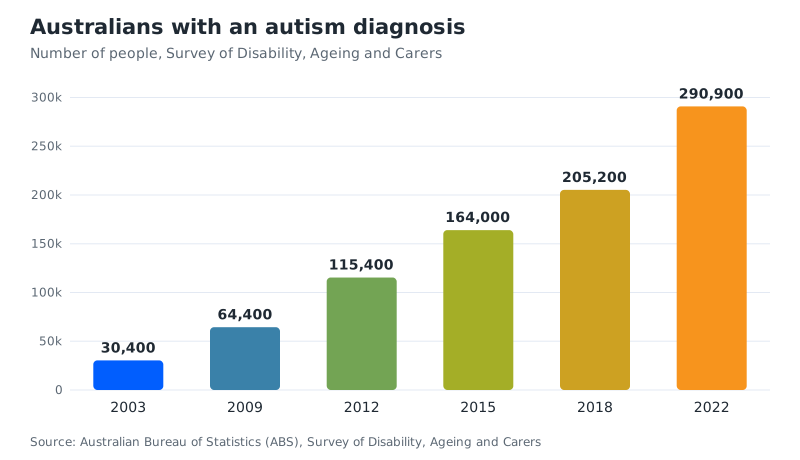
In 2003, about 30,400 Australians had a diagnosis of autism. By 2022 this had risen to about 290,900, or 1.1% of the population (ABS).
In the United States, about 1 in 31 eight-year-old children now has an autism diagnosis (CDC, 2025).
ADHD is one of the most common neurodevelopmental conditions of childhood.
Researchers are still working to understand why diagnoses have risen. Broader diagnostic criteria and greater awareness explain part of the increase, and more research is needed.
With each affected child, parents, siblings and close family are also affected, profoundly and in ways that only those who live through it can understand.
There has been growing professional and public concern about the increase in diagnoses of Autism Spectrum Disorder (ASD) and Attention Deficit Hyperactivity Disorder (ADHD) over recent decades. This article looks at what the latest numbers show, what may explain them, and what the Foundation is doing. Figures updated November 2026, with trends back to 1950.
Autism since the 1950s
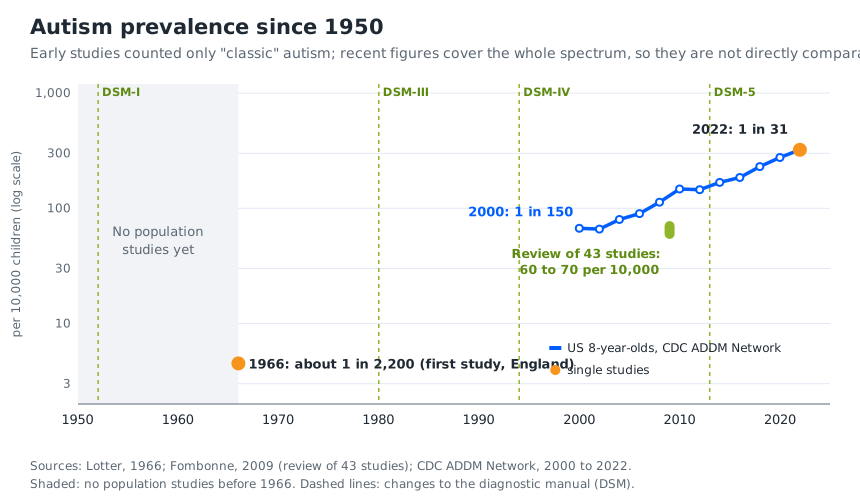
Autism was first described by Leo Kanner in 1943. In the first edition of the Diagnostic and Statistical Manual (DSM-I, 1952) it was grouped with childhood schizophrenia, and it was not listed as a diagnosis in its own right until DSM-III in 1980. There are no population figures from the 1950s: the first prevalence study, in England in 1966, found about 4.5 children in every 10,000, or roughly 1 in 2,200 (Lotter, 1966). By 2009, a review of 43 studies put the whole autism spectrum at about 60 to 70 per 10,000 (Fombonne, 2009). Early studies counted only "classic" autism, while recent figures cover the whole spectrum, so the numbers are not directly comparable.
Autism: the numbers in the United States
The US Centers for Disease Control and Prevention (CDC) has tracked autism among 8-year-old children through its Autism and Developmental Disabilities Monitoring (ADDM) Network since 2000 (CDC, Data and Statistics on Autism):
- In 2000, about 1 in 150 children had an autism diagnosis.
- In 2010, about 1 in 68.
- In 2020, about 1 in 36.
- In 2022, the most recent year reported, about 1 in 31 (3.2%), across 16 sites (Shaw et al., 2025).
Boys were diagnosed about 3.4 times as often as girls in 2022 (Shaw et al., 2025).
Autism: the numbers in Australia
In Australia, the Australian Bureau of Statistics (ABS) Survey of Disability, Ageing and Carers shows a similar trend:
- In 2003, about 30,400 Australians had a diagnosis of autism (ABS, Autism in Australia 2009).
- In 2012, about 115,400, or 0.5% of the population (ABS, Autism in Australia 2012).
- In 2015, about 164,000 (ABS, 2016).
- In 2018, about 205,200, or 0.8% (ABS, 2024).
- In 2022, the most recent survey, about 290,900, or 1.1% of the population, a rise of 41.8% in four years (ABS, 2024).
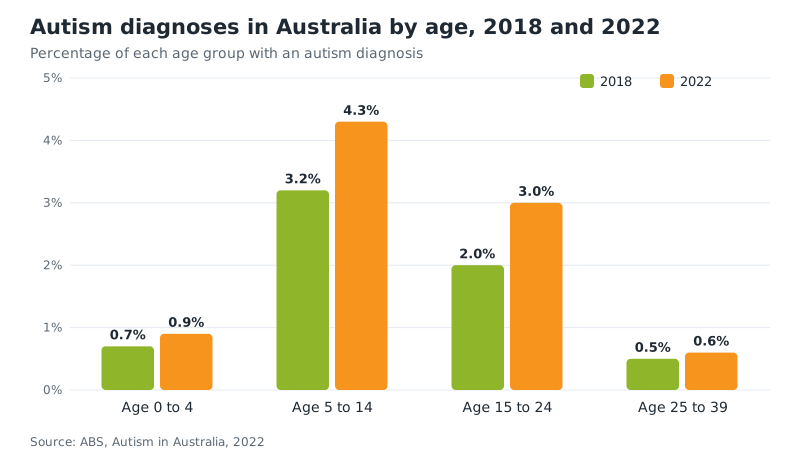
Autism is most often diagnosed in childhood and adolescence. In 2022, 3.1% of Australians under 25 had an autism diagnosis, including 4.3% of children aged 5 to 14, compared with 0.3% of people aged 25 and over. The number of autistic females almost doubled between 2018 and 2022, from 46,500 to 90,900, while the number of males rose from 161,000 to 199,900 (ABS, 2024).
What may explain the increase?
Researchers agree that a large part of the increase reflects changes in how autism is defined and diagnosed. The definition was broadened over time, and in 2013 the DSM-5 brought several earlier diagnoses together under Autism Spectrum Disorder (American Psychiatric Association, 2013). Awareness, screening and access to assessment have also improved, and more girls and adults are now being diagnosed. The ABS notes that changes to diagnostic criteria and survey questions may affect comparisons between survey years (ABS, 2016).
Whether other factors have also contributed is an open question. Genetics plays a major role in autism and ADHD, and researchers are studying how genes may interact with environmental factors, such as conditions during pregnancy, environmental pollutants, and diet. Some of these questions have practical implications. For example, since 2010 the European Union has required foods containing certain artificial colourings to carry the warning (Regulation (EC) No 1333/2008):
"May have an adverse effect on activity and attention in children."
In the United States, the Food and Drug Administration (FDA) revoked the authorisation of the food dye Red No. 3 in January 2025, with food manufacturers required to remove it by January 2027. In April 2025, the US Department of Health and Human Services also announced plans to phase out petroleum-based synthetic food dyes, largely through voluntary industry action (FDA, 2025). Australia has not adopted a warning label requirement. The Foundation believes these questions deserve more independent research.
ADHD: the numbers
ADHD is one of the most common neurodevelopmental conditions of childhood. It is characterised by significant difficulties with inattention, or with hyperactivity and impulsivity, or both.
- In Australia, the national Young Minds Matter survey found that 7.4% of children and adolescents aged 4 to 17, about 298,000 young people, had ADHD in the previous 12 months (Lawrence et al., 2015).
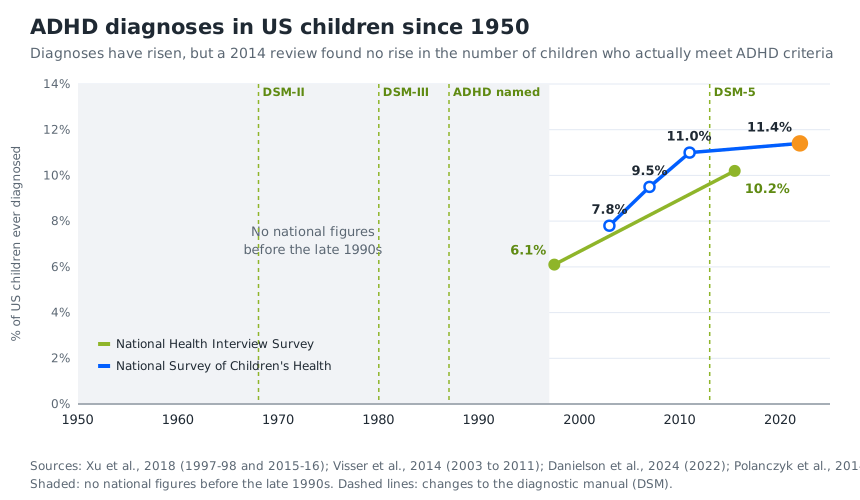
- In the United States, about 7.1 million children aged 3 to 17 (11.4%) had ever been diagnosed with ADHD in 2022, and 6.5 million (10.5%) had a current diagnosis. Boys (13.3%) were more likely than girls (7.5%) to have a current diagnosis (Danielson et al., 2024).
- The US figure has risen over time: 7.8% of children aged 4 to 17 had ever been diagnosed with ADHD in 2003, 9.5% in 2007 and 11.0% in 2011 (Visser et al., 2014).
- ADHD is not only a childhood condition. About 15.5 million US adults (6.0%) had a current ADHD diagnosis in 2023, and more than half of them were first diagnosed as adults (Staley et al., 2024).
ADHD itself is not new. Children with these difficulties were described in the DSM-II (1968) as having "hyperkinetic reaction of childhood", and the name ADHD was introduced in 1987. National figures on diagnosis only begin in the late 1990s: diagnosed ADHD among US children and adolescents rose from 6.1% in 1997 to 1998 to 10.2% in 2015 to 2016 (Xu et al., 2018). However, a review of studies over three decades found no evidence of an increase in the number of children who meet the criteria for ADHD when standardised diagnostic procedures are followed (Polanczyk et al., 2014). This suggests that much of the rise in diagnoses reflects greater awareness and changes in diagnostic practice.
The impact on families
Autism and ADHD can have a profound effect on children and their families. Many children struggle at school, and families can face significant stress and cost in finding support. Children with more severe difficulties may need support throughout their lives. This is why we believe research, reliable information and fair access to services matter so much.
What the Foundation is doing
The Foundation does not provide therapy or treatment. Our work focuses on:
- Public education and advocacy, sharing the findings of published research with families, health professionals and policy makers.
- Raising funds for independent, ethics-approved research into the causes of autism and ADHD.
- Working towards a research and education centre, in partnership with universities and researchers.
- Publishing research findings in scientific journals.
The information in this article is general information only. If you have concerns about your child, please speak with your GP or another qualified health professional.
References
- American Psychiatric Association (2013). Diagnostic and Statistical Manual of Mental Disorders, Fifth Edition (DSM-5). Washington DC. psychiatry.org/psychiatrists/practice/dsm
- Australian Bureau of Statistics. Autism in Australia, 2009 (cat. no. 4428.0). Canberra: ABS. abs.gov.au
- Australian Bureau of Statistics. Autism in Australia, 2012 (cat. no. 4428.0). Canberra: ABS. abs.gov.au
- Australian Bureau of Statistics (2016). Disability, Ageing and Carers, Australia: Summary of Findings, 2015 (cat. no. 4430.0). Canberra: ABS. abs.gov.au
- Australian Bureau of Statistics (2024). Autism in Australia, 2022. Canberra: ABS. abs.gov.au/articles/autism-australia-2022
- Centers for Disease Control and Prevention. Data and Statistics on Autism Spectrum Disorder. cdc.gov/autism/data-research
- Danielson, M.L., Claussen, A.H., Bitsko, R.H., et al. (2024). ADHD prevalence among U.S. children and adolescents in 2022: diagnosis, severity, co-occurring disorders, and treatment. Journal of Clinical Child & Adolescent Psychology, 1-18. doi.org/10.1080/15374416.2024.2335625
- European Parliament and Council (2008). Regulation (EC) No 1333/2008 on food additives. eur-lex.europa.eu/eli/reg/2008/1333/oj
- Lawrence, D., Johnson, S., Hafekost, J., et al. (2015). The Mental Health of Children and Adolescents: Report on the second Australian Child and Adolescent Survey of Mental Health and Wellbeing. Canberra: Department of Health. youngmindsmatter.thekids.org.au
- Shaw, K.A., Williams, S., Patrick, M.E., et al. (2025). Prevalence and early identification of autism spectrum disorder among children aged 4 and 8 years: Autism and Developmental Disabilities Monitoring Network, 16 sites, United States, 2022. MMWR Surveillance Summaries, 74(2). cdc.gov/mmwr/volumes/74/ss/ss7402a1.htm
- Staley, B.S., Robinson, L.R., Claussen, A.H., et al. (2024). Attention-deficit/hyperactivity disorder diagnosis, treatment, and telehealth use in adults: National Center for Health Statistics Rapid Surveys System, United States, October-November 2023. MMWR Morbidity and Mortality Weekly Report, 73(40). cdc.gov/mmwr/volumes/73/wr/mm7340a1.htm
- US Food and Drug Administration (2025). FDA encourages food manufacturers to accelerate phasing out use of FD&C Red No. 3 in foods ahead of 2027 deadline. fda.gov
- Fombonne, E. (2009). Epidemiology of pervasive developmental disorders. Pediatric Research, 65(6), 591-598. pubmed.ncbi.nlm.nih.gov/19218885
- Lotter, V. (1966). Epidemiology of autistic conditions in young children. Social Psychiatry, 1, 124-135. doi.org/10.1007/BF00584048
- Polanczyk, G.V., Willcutt, E.G., Salum, G.A., Kieling, C. & Rohde, L.A. (2014). ADHD prevalence estimates across three decades: an updated systematic review and meta-regression analysis. International Journal of Epidemiology, 43(2), 434-442. pubmed.ncbi.nlm.nih.gov/24464188
- Visser, S.N., Danielson, M.L., Bitsko, R.H., et al. (2014). Trends in the parent-report of health care provider-diagnosed and medicated attention-deficit/hyperactivity disorder: United States, 2003-2011. Journal of the American Academy of Child & Adolescent Psychiatry, 53(1), 34-46. pubmed.ncbi.nlm.nih.gov/24342384
- Xu, G., Strathearn, L., Liu, B., Yang, B. & Bao, W. (2018). Twenty-year trends in diagnosed attention-deficit/hyperactivity disorder among US children and adolescents, 1997-2016. JAMA Network Open, 1(4), e181471. pubmed.ncbi.nlm.nih.gov/30646132
Frequently asked questions
Why are autism diagnoses increasing?
Much of the rise reflects broader diagnostic criteria, greater awareness and better access to assessment. A Danish study found that changes in diagnosis and reporting explained about 60% of the increase there (Hansen and colleagues, 2015). Researchers continue to study what explains the rest.
Is ADHD becoming more common, or just diagnosed more often?
A review of studies over three decades found no increase in the number of children who actually meet ADHD criteria, which suggests that rising diagnosis rates mainly reflect better recognition (Polanczyk and colleagues, 2014).
How many Australians have an autism diagnosis?
290,900 in 2022, up from 205,200 in 2018, according to the Australian Bureau of Statistics.
Help fund research into autism and ADHD
The Australian Autism ADHD Foundation is a not-for-profit organisation, and this information is free for everyone. Donations fund independent research, education and advocacy for autistic people, people with ADHD and their families. Donations of $2 or more are tax deductible.